
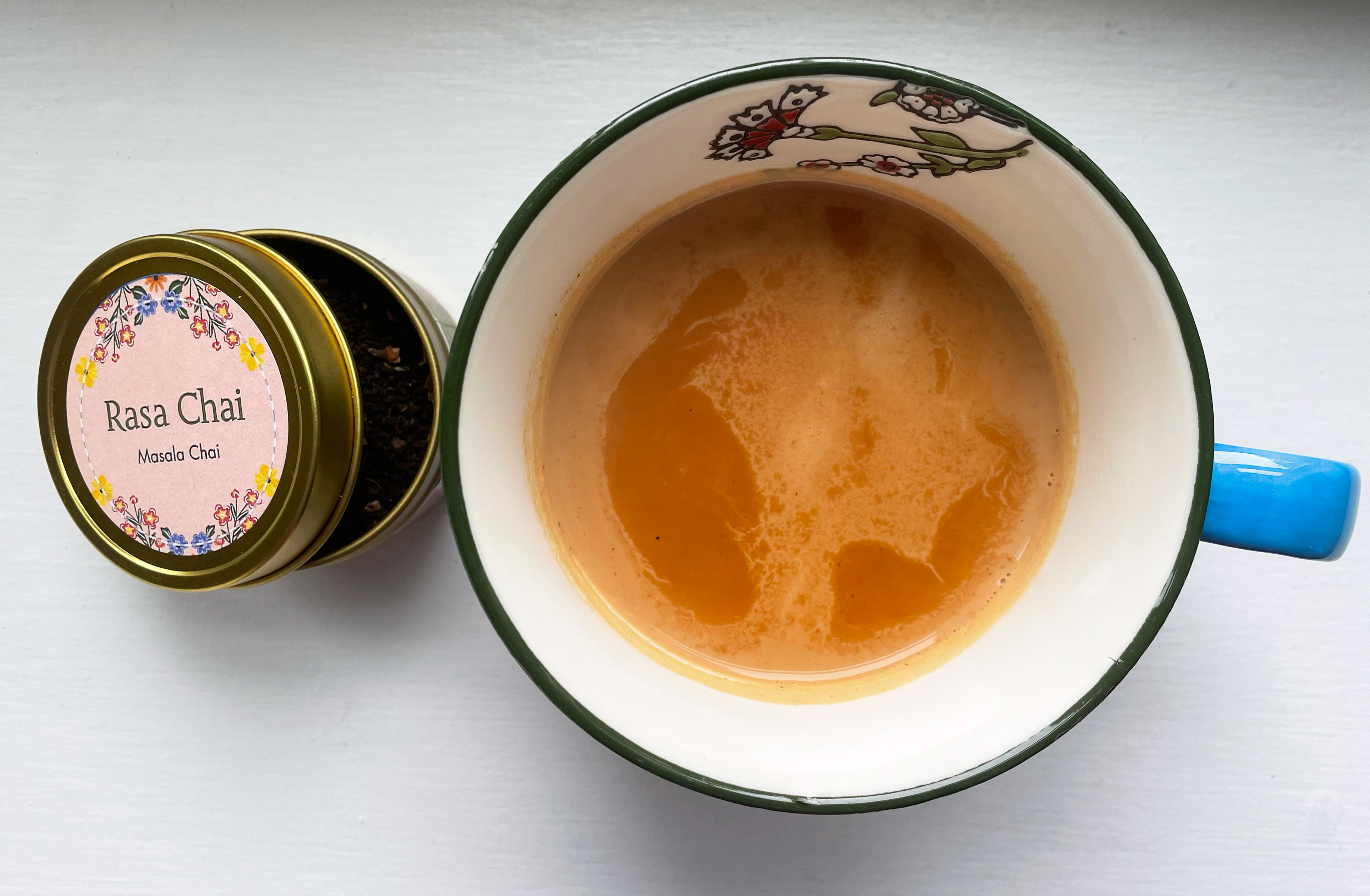
I am bringing back my “Thé Time” column after four (!!!!) long years. I wouldn’t bring it out of retirement for anything that wasn’t really, really good. So, without further ado, I bring you Rasa Chai.
I found out about Rasa Chai a few weeks ago at work. As part of my new job, I’m scouting out stories about people at Washington University in St. Louis including alums who are making a difference in the region, whether it’s through service, innovation, entrepreneurship, education, or other areas. I heard about Shradha Challa, MBA 2024, who started Rasa Chai while she was a student at Olin Business School and has continued to grow her business since she graduated this past spring.
Shradha got the idea for Rasa Chai while she was taking an Intro to Entrepreneurship class at Olin. Her professor encouraged her to look for a problem she could solve with a new business. She started thinking about how difficult it was to find a cup of authentic chai in St. Louis.
“Here in the U.S., I can’t find one cup of authentic chai,” Shradha said in an article from Olin Business School. “And that’s how I came up with the idea for Rasa Chai. It started as my own problem, but the more I did research, the more I found that other people share this problem. There are so many South Asians here and they want the convenience of going and grabbing a chai somewhere.”
This inspired Shradha to start her business, which offers handcrafted chai blends in the most exquisite containers, as you can see in the photo at the top of this post. I ended up buying one a couple weekends ago at the University City Farmers’ Market, where Shradha was offering free samples, selling cups of freshly brewed chai, and selling containers of classic masala chai, which has cinnamon, cardamon, cloves, and fennel, and haldi chai, which is the same blend but with turmeric and ginger added in.
I tasted both blends and fell in love with the masala chai. It is fragrant, comforting, and delicious. It’s so good that I’m actually stepping away from writing this blog post for a second to go brew a cup. I’m not joking.
I think Shradha is right when she says it’s difficult to find a good cup of chai in the U.S. I pretty much gave up on buying it at a coffee shop or bakery, partly because I used to work at a bakery so I know what is done behind (semi) closed doors. So much of “freshly made” chai is actually a powder blended with milk, or, dare I say, worse: A syrup that is mixed into hot milk. I told a friend this recently when we were discussing chai and you could see a light bulb go off in her head. “Wow,” she said. “That’s why it doesn’t taste as good.”
Over the years, I’ve started to buy different loose leaf chai blends, which taste waaaay better than 90% of what you can buy at a coffee shop. I’ve found a few that I really like, including this one from Kolkata Chai Co. in New York, but Rasa Chai is my new favorite. Why? you might ask. Partly it’s because I can tell that the spices and tea are so fresh, and also, it’s very easy to make at home. Sometimes you find a loose leaf chai blend that tells you to mince and add two tablespoons of fresh ginger or go through a whole rigamarole to brew a cup. I don’t mind mincing ginger or doing a few extra steps to produce a really good beverage once in a while, but sometimes, I just want to drop a couple teaspoons of tea in hot water, brew it quickly, add milk, and call it a day.
That’s the beauty of Rasa Chai. As Shradha told me when I saw her at the market, all you have to do is add a little of the tea blend to hot water, brew it, add some milk, strain it, and then you have one of the best cups of chai you’ve ever had in your life. She probably didn’t say the very last part-I am editorializing-but it’s true.
Anyway, before I wax poetic about Rasa Chai for too long, I highly recommend that you go purchase some and try it for yourself. If you’re in St. Louis, you can also stop by the University City or Boulevard farmers’ markets on the weekend, where Shradha sells her chai. I guarantee that you will be impressed with the quality and flavor.

 allezlefood.com