Earl Grey Morning Buns with Chocolate Custard Filling

20BECBBE-1FA0-4BD3-92D6-0ACFBCE8310C
I’ve wanted to make these Earl Grey morning buns for a *very* long time, but I never got around to it, partly because they’re a commitment and partly because they require some difficult-to-find ingredients. For example, how many of us can readily find vanilla bean paste in the grocery store? Maybe you can, but then you’re luckier than I am.

However, shelter-in-place has actually been a boon to my baking because if I can’t find an ingredient in the store, I can probably find it online for even cheaper. Yes, it takes some digging and price comparison, but at the end of the day, I usually get what I need. I would recommend Amazon as a great source of ingredients. You can usually find what you need for cheaper than store prices and it ships to your house, so you avoid the store entirely.

I ordered some loose leaf Earl Grey tea to make these buns and cacao nibs for the filling and outside. I also got the aforementioned vanilla bean paste, which smells like heaven and makes me want to use it in everything.

Even though I love the flavor and texture combinations in these buns (fragrant Earl Grey tea, sweet chocolate and sugar, tangy and crunchy cacao nibs), they got me thinking about other combinations. I might do a lemon lavender bun soon because I think that would work well. My boyfriend wants buns with a cinnamon sugar interior, which I think would also be delicious. Honestly, the possibilities are endless. You just have to make minor tweaks to the dough and find or create another filling that works for you.

I like to store my buns in the refrigerator in an airtight container after day one so they keep longer. If you want to bring them back to day one status, just reheat them in the microwave for 30 seconds to a minute. The sugar filling on the outside will melt a little but they still taste as good. I ate one alone this morning and I made it last by taking apart each layer and eating it separately.

ANYWAY. Here is the recipe for the buns. The only note I’d have is to be very careful when you’re making the chocolate custard. The eggs and milk can curdle easily, so err on the side of using too little heat than too much. Also, stir the entire time so you further reduce the chance of curdling.

Here’s a song to get you started on your Earl Grey morning bun journey.


Posted in Breakfast, Uncategorized | Tagged , , , , , , , , , , , , , , , , , , , | Leave a comment

Blueberry Cornmeal Scones from Sister Pie

3D6FD01F-EC5D-44AF-87A7-4AD91F6BE2F1
Some of my favorite recipes during shelter in place come from bakeries that I’ve visited or would like to visit. In lieu of serving customers, many bakeries are posting recipes for popular menu items on social media. These blueberry cornmeal scones from Sister Pie bakery in Detroit are a perfect example.

I saw the recipe on Eater yesterday after they wrote an article about how the bakery posted the recipe on Instagram. I immediately knew I had to make them. I love cornmeal in baking because it gives pastries a hearty, reassuring cornbread taste and some crunch. It’s good to have multiple textures going in most dishes but especially baked goods. No one wants a mushy scone.

These scones are basically like cornbread with a scone snuck in, but I’m totally okay with that. They have juicy blueberries scattered in, plenty of butter and sugar, and a touch of heavy cream to bind everything together.

My favorite part of making these scones was actually the labor-intensive process. Okay, you’re probably thinking to yourself right now, shelter in place is really getting to her. But seriously, making scones the old-fashioned way is fun and less stressful than taking out a food processor and stand mixer. You basically need two tools: your hands. You also probably need a big bowl and a bench scraper and pastry cutter, but those are good investments for any baker, anyway.

I was a little worried about how they would turn it, but luckily, the recipe from Sister Pie is very thorough. It even tells you what kind of pressure to use when you’re forming your dough. It’s approachable enough for any baker, even if you’ve never made scones before.

I had a scone fresh out of the oven and then I had another one this morning for breakfast with a pot of tea. My boyfriend has basically been eating them nonstop which is pretty par-for-the-course with whatever I make, but the faster something goes, the more I know he likes it.

Here’s a song to get you started on your blueberry cornmeal scone journey.

Posted in Breakfast, Uncategorized, Vegetarian | Tagged , , , , , , , , , , , , , , , | Leave a comment

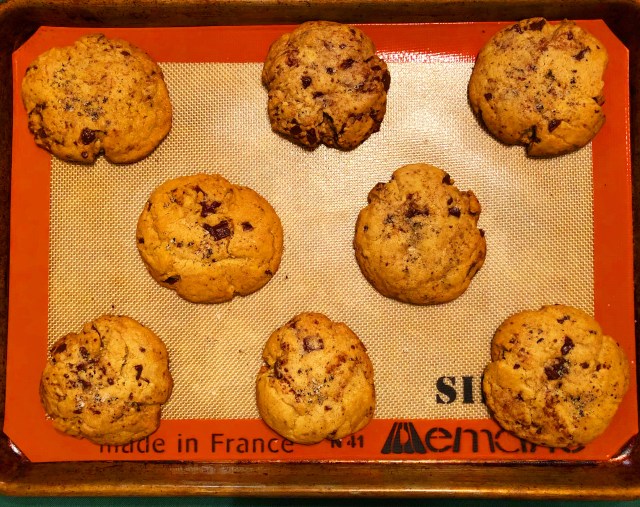
Bourbon Chocolate Chip Cookies with Vanilla Sea Salt

BDF0FA60-647C-43EF-A729-43A2A978C2F2.JPG
I was going to tell you that these are the best chocolate chip cookies I’ve ever made, but that would be unfair to all the other ones I’ve made over the years. You can check out those recipes in my definitive ranking of chocolate chip cookies.

However, these cookies are delicious and probably one of the best chocolate chip cookies I’ve ever made, by virtue of two things: Bourbon and vanilla sea salt. I’m a fan of putting bourbon in anything, but they have a special place in these cookies, which also have rye flour and big chunks of dark chocolate.

Also, as anyone who reads this blog knows, I’m a fan of putting sea salt on cookies. In this recipe, I mixed sea salt with seeds from a vanilla bean, so there’s an extra layer of flavor on top. I love the way the vanilla pairs with the bourbon.

A couple notes about making these cookies: One, you’ll need to chill the dough for a while. This can be annoying, especially when you want cookies ASAP (and, let’s face it, we all want cookies ASAP). But commit to the chill and you’ll be rewarded with soft, pillowy cookies that practically melt in your mouth.

Second, you’ll want to press down the dough balls a little before you put the cookies in the oven. This will allow them to spread more evenly and not become too dense. I used the palm of my hand and applied gentle pressure. Don’t slam your hand down on top because the dough is fragile from being in the fridge, and then they might fall apart.

My boyfriend and I have been eating at least of couple of these cookies a day since I made them the other night. He told me they’re better than the ones we sometimes order from a local pizza place for dessert, which was a high compliment because those cookies are delicious.

Here’s a song to get you started on your bourbon chocolate chip cookie journey.

Bourbon Chocolate Chip Cookies with Vanilla Sea Salt

Ingredients

1 1/2 cups dark chocolate wafers or chunky chips, divided
2 cups all-purpose flour
1/2 cup rye flour
1/2 tsp baking soda
1 1/2 tsp kosher salt
3/4 cup plus 1 Tbsp unsalted butter, room temperature
3/4 cup dark brown sugar
3/4 cup granulated sugar
1 large egg, room temperature
1 1/2 tsp vanilla extract
2 Tbsp bourbon
1 vanilla bean, split lengthwise
1 tsp flaky sea salt

Directions

Pulse the wafers or chunky chocolate chips in a food processor until small pieces form. Set aside.

Whisk the AP flour, rye flour, baking soda, and salt in a large bowl and set aside. Then beat the butter, brown sugar, and granulated sugar in a mixing bowl on medium high speed until light and fluffy. Add the egg, vanilla extract, and bourbon and beat until incorporated. Reduce the speed and add the dry mixture until it’s incorporated.

Scoop balls of dough (1/4 cup worth) out of the bowl and put them on a baking sheet lined with parchment paper. Cover the sheet and place it in the fridge for at least two hours and up to a day.

When you’re ready to bake, preheat the oven to 350 degrees. Line two rimmed baking sheets with parchment paper or silicone baking mats. Mix the sea salt with vanilla bean seeds. Place dough balls at least 3 inches apart on the prepared baking sheets and press down on the top gently to flatten them slightly. Sprinkle with the vanilla sea salt. Bake for 15-18 minutes until the cookies are golden brown around the edges but soft in the middle. Remove the sheets from the oven and let the cookies cool for a couple minutes, then let them cool the rest of the way on a wire rack. Store in an airtight container. Enjoy!


Posted in Cookies, Dessert, Uncategorized | Tagged , , , , , , , , , , , , , | Leave a comment

PB and Jam Oats

C9EB8A01-642E-416F-9CC1-3E6354D9B3B5.JPG
My breakfasts during quarantine have been…how do I say…eclectic. One day I’m eating an everything bagel with avocado, the next I’m having chocolate covered doughnuts. In a way, that’s really good because it breaks me out of my usual routine. In another way, it feels like the rollercoaster this time period is.

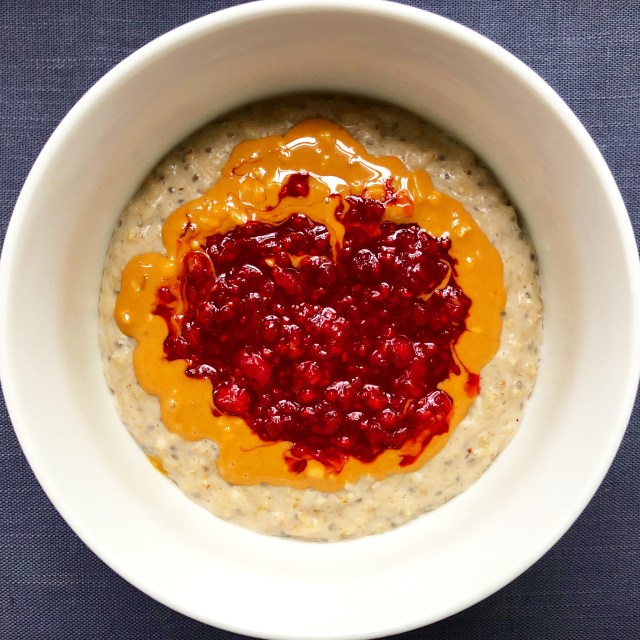
Either way, having more time in the morning has given me a chance to experiment more with what I make, so that’s positive no matter how you spin it. This morning I decided to make PB and jam oats. It looks like it would be time consuming, but it’s actually the easiest thing to make.

First, make your “jam.” I say jam in quotation marks because it doesn’t require all the usual work of jam but still has the same consistency and flavor. You take fresh or frozen berries, mix them with a little sugar in a saucepan, and heat it over low. If the berries are frozen like mine were, they’ll start to defrost and break down. Once the berries are completely thawed and breaking down, you turn the heat up a little, mash things down with a spoon, and stir for a couple minutes until the mixture has a jammy consistency.

You can make your oatmeal according to my recipe below, or you can use your favorite recipe. For the peanut butter topping, you just put a couple tablespoons of peanut butter (crunchy all the way…do not argue with me on this) in a microwave-safe bowl and heat it for 10 seconds at a time, stirring in between, until the peanut butter has melted. Then, you ladle it on top of your oatmeal, add some of your jam, and swirl it all together.

If you’re a fan of peanut butter and jam sandwiches you’ll love this oatmeal. Or, if you’re a fan of oatmeal and you want to change up your usual routine, this is also a great option.

Here’s a song to get you started on your PB and jam oats journey.

PB and Jam Oats

Ingredients

for the jam:
1/2 cup fresh or frozen raspberries
2 Tbsp granulated sugar

for the PB topping:
2 Tbsp peanut butter

for the oatmeal:
1/2 cup rolled oats
1 cup almond milk (or your choice)
2 Tbsp chia seeds
1 Tbsp maple syrup
1/2 tsp ground cinnamon

Directions

First, make your jam. Combine the berries and sugar in a small saucepan and heat on low. Once the sugar has dissolved, give everything a stir. When the berries are completely defrosted (if you’re using frozen) and the fruit is starting to break down, turn the heat up to medium and stir for a couple minutes, mashing down berries with the back of your spoon. Remove from heat while you make your oatmeal.

To make the oatmeal, combine the rolled oats, milk, maple syrup, and cinnamon in a medium saucepan. Bring the mixture to a boil over high heat then turn down the heat to keep the oatmeal at a simmer. Cook, stirring occasionally, until the oatmeal has the consistency you like. I like mine thicker. Stir in the chia seeds during the last couple minutes of cooking.

To make the peanut butter topping, microwave the peanut butter in a microwave-safe bowl for 10-second increments, stirring between each one. It took 20 seconds for mine to melt.

To assemble your oatmeal, pour the cooked oats into a bowl and top with your peanut butter and jam. Swirl with a toothpick or a spoon. Enjoy!

Posted in Breakfast, Uncategorized, Vegan, Vegetarian | Tagged , , , , , , , , , , , , , , , , | Leave a comment

In Defense of Salted Butter

15AC0210-55E2-4DCE-810C-09530150680A
If you’re a frequent home baker and cook like I am, you’ll notice that recipes usually call for unsalted butter. There’s a reason for this. Most recipes, especially those for cakes, cookies, and other sweets, are formulated to include a very specific amount of salt. It’s usually added later when you’re making batter or dough, and it’s calibrated by taste. This means the person who made or tested the recipe adjusted the salt level to his or her palette.

Recently, I started reading “Salt, Fat, Acid, Heat” by Samin Nosrat, a chef who teaches people how to cook by helping them understand the four main elements of any dish. I’d perused the book before and even made a recipe from it, but I didn’t read it front to back like Nosrat suggested because honestly, it’s a time-consuming endeavor. Now that I have plenty of time on my hands, I can devote some attention to it.

In the first chapter of the book, she talks about salt and how we usually under-salt a dish. She also talked about figuring out how much salt to add by taste. It’s trial and error, and it’s an intimidating process for most home cooks. But if you persevere and give yourself some time to make mistakes and learn, you’ll be rewarded with better tasting food.

I’ve internalized this lesson over the past year and I’ve found that there’s a huge difference in the food I cook and bake. It tastes better and less bland. It’s true that when you’re scared of salt (and trust me, it’s normal to feel this way), you err on the side of under-salting a dish, which in turn leads to food that is a little more flavorless. Salt *enhances* flavors and doesn’t hide them. If you mess up it can obscure them, but as Samin says, everyone makes mistakes.

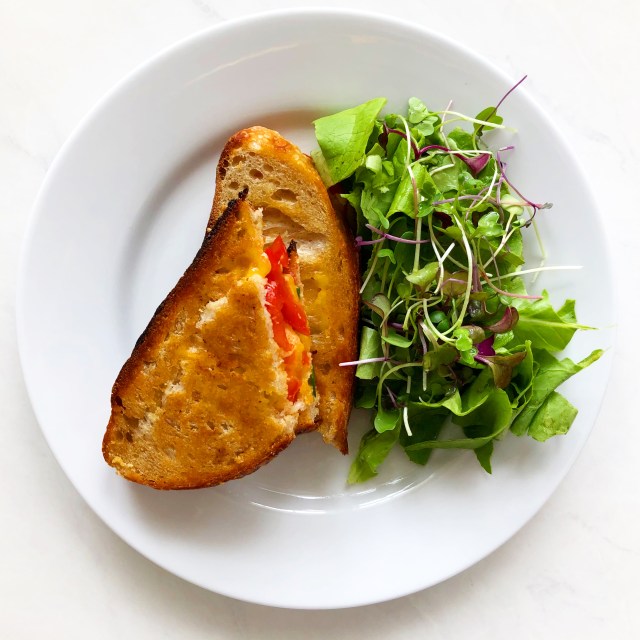
Which brings me to salted butter. I’ve subbed it in some recipes that call for unsalted butter and then adjust the fine sea salt later. I also use it in the place of unsalted butter when I’m making food like the grilled cheese I’ve pictured above.

That particular grilled cheese was the best I ever made, and it wasn’t only because of the flavor components inside, although those were great. I had melted cheddar cheese, which has a little bite to it, fresh farmers’ market scallions and tomatoes, and sourdough bread that I’d baked the Friday before. But it all came together when I fried it in salted butter. The exterior of the bread became crunchy, golden brown, and slightly salty, kind of like the way the outside of a French fry tastes when you sprinkle some salt on it. It tied everything together and made the sandwich taste even better.

I think there’s a good argument to be made for using unsalted butter in recipes. After all, most people do it. It allows you to add salt in specific amounts later, which is generally easier and wiser if you want to taste as you go.

However, I’d urge you to take a chance on salted butter. I think it’s an under-appreciated ingredient. Try it in brownies or cookies, or even when you’re frying food. It will make your flavors pop even more and take your food to the next level. It might involve some trial and error, but once you get the hang of it, you’ll probably be like me and buy a pack every time you go the grocery store.

In honor of salt, here’s a song from one of my favorite salt-friendly bands.

Posted in Uncategorized | Tagged | 1 Comment

Vegan Chocolate Chip Cookies from Levee Baking Co.

B62B0405-EA8F-45F9-9C00-6435B2AD2221.JPG
The other day, I got really worked up about a piece in Esquire about how the restaurant revolution is ending. I’m not sure why, aside from the fact that it was a huge insult to anyone living in the Midwest and that it peddled pessimistic untruths about our society. I guess what I’m trying to say is, I should have let it roll off my back, but for some reason, I couldn’t.

Thank goodness for these cookies from Levee Baking Co. I’d reached a high point of anger and I was scrolling through Instagram in a semi-blind haze, looking for any and all distractions. I saw a photo with a recipe for vegan chocolate chip cookies from Levee. “Done,” I thought. The recipe looked simple enough; it only involved one bowl and ingredients that I already had on hand.

I knew the cookies would be good because everything at Levee is delicious. If you’re ever in New Orleans, I’d highly recommend you check them out. Everything they make reflects the artistry and adeptness of the chefs.

However, I didn’t realize these cookies would be the best ones I’ve ever made. I know I say that a lot, but I’m telling the truth. The only cookies I like as much as these are my recipe for cherry chocolate chip cookies. These vegan chocolate chip cookies are packed full of ingredients including shredded coconut and rolled oats. My boyfriend said they taste a little like macaroons, which is true. They have that texture going for them, but they also have so much more: melted chocolate chips, sea salt, cinnamon, and brown sugar.

They’re rich and reassuring. Honestly, they’re the perfect self-isolation cookie. They’re also super easy to make, so you can do it when you have some down time. Although to be honest, we probably all have a lot of down time these days.

I’ve included the recipe below, but you can also find it on Levee Baking Co’s Instagram account.

Here’s a song that reminds me of these cookies.

Vegan Chocolate Chip Cookies from Levee Baking Co.

Ingredients

53 g rolled oats
53 g shredded coconut
68 g brown sugar
1/2 tsp salt
1 tsp baking powder
1 tsp cinnamon
2 Tbsp maple syrup
125 g natural peanut butter or other nut butter (I used almond)
5 g flax plus 3 Tbsp water
1 tsp vanilla extract
49 g chocolate chips (vegan or not)
flaky sea salt for sprinkling

Directions

Preheat the oven to 350 degrees F. Line a baking sheet with parchment paper or a silicone mat.

Mix the flax plus water and let it sit for a second. In a separate bowl, combine it with all the ingredients. Scoop dough on to the baking sheet, placing balls about one inch apart. Bake at 350 degrees F for about 10-12 minutes. Take them out of the oven and sprinkle on some flaky sea salt. Let them cool (if you can). Enjoy!

Posted in Cookies, Dessert, Uncategorized, Vegan | Tagged , , , , , , , , , , , , , , , , , , | Leave a comment

Dimanche (That Means Sunday)

D9E0F3CD-8524-4F7C-9AF3-82728CB001BD.JPG
Welcome to this edition of Dimanche (That Means Sunday), a roundup of things that caught my eye this past week.

Spring is officially here in St. Louis. I took a couple sanity walks last week after finally securing a bandana and face mask. I stopped a few times to look at the beautiful spring flowers. I would encourage you to do the same. Step outside with a face mask and bandana and take a stroll around the block, making sure to stay far away from anyone else in the vicinity. Social distancing is real, and we all need to take precautions to make our community safer for one another.

That being said, there’s still plenty to enjoy. I know not everyone is enjoying consistent spring weather (hi, Boston), but eventually, it will be spring. Being in nature has always helped me recenter and concentrate on what’s important. In trying times like the ones we’re in now, it’s extra important to take a minute to clear our heads and focus on something that isn’t news or COVID-19-related.

Last night I drove to pick up a pizza curbside at Union Loafers, one of my favorite restaurants in town. It was an early pickup and so the sun was just starting to set as I drove home. Driving west on I-64, you eventually come up on Forest Park on the right. For those of you who are unfamiliar with the park, it’s the biggest one in St. Louis and usually a popular spot for locals and tourists.

It’s a little quieter now, obviously, but you still see people getting exercise on the walking and bike paths. To be honest, I wish more people were wearing masks, but that’s a separate issue. Yesterday when I drove by, I noticed that the trees in the park had fresh green-yellow buds that glimmered in the late afternoon sunlight. It seemed like almost overnight, the trees had burst into bloom. I saw bright pastel-colored flowers and branches swaying in the breeze.

In a way, it felt bittersweet because I can’t enjoy it as much as I usually would. But then, I realized this experience makes me appreciate it even more. Not being able to have something you usually take for granted gives you new eyes.

We don’t know what next year will bring in terms of next steps, but we do know that it will bring another spring. That’s reassuring to me. I hope that I can be out in nature more next year and go on more road trips and hikes, but for now, I’m content with my walks around the neighborhood and nearby parks. It still offers me the opportunity to appreciate nature and this sudden spring.

Without further ado, here is Dimanche:

I *love* this story about making a French omelette. The writer goes to cooking school in France and watches as a head chef chastises a student for his faulty attempts at making an omelette. There’s an art to it, for sure. Read more in this New Yorker story.

Can we talk about how adorable this story about puppies during the pandemic is? This is the content I live for. Read more about the recent uptick in puppy adoptions in this Boston Globe piece.

I think that even more than politically, we’re in an important moment culturally. I love this story about musicians playing on rooftops in Iran during the pandemic. It’s very inspirational. Read more in AFAR.

French people love their movies, so it’s no surprise that the film industry there is soldiering on during the pandemic. The government, the Centre national du cinéma et de l’image animée (CNC), and Unifrance, an organization devoted to French films, are all doing their part to keep people in the industry informed and to share films with a wider audience. Read more in this IndieWire piece.

As usual, The Atlantic came through this week with a wake-up call. The magazine ran a sad but true story about how our lives won’t get back to normal too quickly after the U.S. reopens. The story is broken up into sections that cover different phases of the pandemic. “There is no going back. The only way out is through—past a turbulent spring, across an unusual summer, and into an unsettled year beyond,” writes Ed Yong in the story. I think it’s important to stay positive while realizing the hard truths of the situation.

Native Americans are responding to a food crisis during the pandemic. Getting food is often a challenge for individuals living on reservations, but now the problem is compounded. Read more about how people are creatively and resourcefully responding to the crisis in this New York Times story.

Kudos to Katie Lee Collier, a local restaurant entrepreneur, for making a shrewd business move during the pandemic, which has taken its toll on local businesses. Collier, who owns the wildly popular Katie’s Pizza & Pasta Osteria with her husband, Ted, recently decided to pivot to selling frozen pizzas and pastas. So far, it’s been a huge success. Read more in this St. Louis Magazine article.

Last but certainly not least, food writer Jeff Gordinier wrote an article in Esquire about how the restaurant revolution as we know it is ending. I disagree. Read my response in my latest blog post.

Enjoy your week! Here’s a song to get you started.

Posted in Dimanche (That Means Sunday), Uncategorized | Tagged , , , , , , , , , , , , , , , , | Leave a comment

Response to Jeff Gordinier’s Esquire Piece

Last night, I was scrolling through Twitter when I saw this tweet from Kim Severson, food correspondent for The New York Times:

I was skeptical because as Severson correctly identifies in her tweet, Gordinier in his Esquire story argues that the restaurant revolution is over due to the recent turn of events, and I do not agree with this assessment. Still, I read on because I wanted to see what he had to say. I generally give someone the benefit of the doubt.

I thought about staying quiet about the article, but honestly, it has unsettled me so much since I read it last night that I have to say something. There’s no doubt in my mind that the Trump administration has jeopardized the fate of small businesses including many local restaurants due to its outrageous allocation of funding. It’s also true that a pandemic puts restaurants and local eateries in a difficult position. However, there is no doubt in my mind as a food lover and patron of these businesses that they will survive, as long as we commit to supporting them. Although people are framing the article as a purveyor of harsh realities, the truth is that it’s trying to predict the future and in a completely negative way. Now is the time for relentless optimism, even while we’re cautious and cognizant of what’s happening in our society.

Second, this article is an insult to anyone living in the Midwest. At one point, Gordinier writes that our region is “shorn of funk,” which is to say bereft of anything that is not generic or mass produced. This is a huge slap in the face to people who have worked hard for years to build a business in this region. It also reflects an East Coast elitism that I find distasteful and frankly, disappointing. Gordinier should not be surprised or excited that these things exist; he should try a little harder to do his job as a food writer covering the national food scene, and realize that there are wonderful places producing quality food in small towns, suburbs, and cities such as St. Louis, which, by the way, has always been a liberal stronghold in an otherwise red state. Yes, food writing is inherently political, but if you’re going to bring politics into it, do not make generalizations.

People will continue to support great restaurants like Balkan Treat Box and Indo and so many others in the Midwest because we recognize that they’re an integral part of our community. Plus, I’m a strong believer that passion, drive, and talent will always be rewarded. Gordinier purports that restaurants will be “killed off by the culture wars,” but I feel like the food revolution in the Midwest and nationally is only beginning.

Posted in Uncategorized | 2 Comments

Tomato and Scallion Grilled Cheese

15AC0210-55E2-4DCE-810C-09530150680A.JPG
Everyone should have a good grilled cheese recipe in their back pocket. This is mine.

I decided to add scallions and tomatoes to my traditional cheddar grilled cheese to use up some of my farmers’ market produce. I first had the idea to put tomatoes in the grilled cheese, and then I thought of the flavor combo with scallions. I cut up a few and sprinkled them on the tomatoes and cheddar cheese before I fried the sandwich.

It turned out to be a great move. Scallions take the sandwich up a notch. There’s nothing wrong with plain grilled cheese, but every once in a while, you need to spice things up. I’m beginning to think it’s the little things that elevate a dish from average to awesome.

There’s really not a “recipe” for this grilled cheese. Take two slices of bread (I used homemade sourdough), layer on thin slices of cheddar cheese, thinly-sliced tomatoes, and chopped scallions. Melt about a tablespoon of butter in a frying pan and swirl to coat the pan. Cook the grilled cheese, pressing it down with a spatula, until one size gets golden brown. Carefully flip the sandwich and repeat the process. The grilled cheese is done when both sides are golden brown, the cheese is melted and gooey, and you can’t wait any longer to eat it.

A word about butter: I used salted butter for this grilled cheese and I found that it made a big difference. I’m going to write a blog post soon about why salted butter gets a bad rap. I get that baked goods rely on unsalted butter to prevent them from becoming too salty, but for everyday cooking and even most baking projects, salted butter should get more respect.

Anyway, I digress. Stay tuned for my blog post about salted butter. Meanwhile, I’ll leave you with this song.

Posted in Dinner, Lunch, Uncategorized, Vegetarian | Tagged , , , , , , , , , , , , , , , , , , | Leave a comment

Sourdough Bread

B3FC84B4-F05B-41C5-8E7F-E3AD71CA2066.JPG
Five years ago when I was living in DC, I was browsing a local bookstore and one book caught my eye, “In Search of the Perfect Loaf: A Home Baker’s Odyssey.” In the book, local author and home baker Samuel Fromartz shares his experiences working in a French boulangerie and subsequently traveling around Europe and the United States to learn more about bread making. The book is small yet mighty, in that it looks like an unassuming paperback but it’s actually full of great tips for making bread at home.

After reading the book, I did what any self-respecting journalist would do; I tracked down Fromartz. I emailed him and asked if I could have some of his sourdough starter. At the time, my dream was to make a baguette, and I wanted to start with the best dough possible. To my surprise, Fromartz replied to my email and told me he’d give me some starter.

Then I decided to move back to St. Louis. While moving cross country and resettling in my hometown, I completely forgot about my bread aspirations. Or maybe I didn’t forget, but I was satisfied to sample bread from local bakeries such as Union Loafers and KNEAD, which are doing great things with sourdough.

I actually got a tiny bit of experience making bread when I did a short stint at a bakery in St. Louis after I moved back home. My main takeaway was how to shape a loaf. There’s a specific process that involves taking the dough, folding it up, and rolling it toward you. The pressure from the surface and your hands creates tension, which forms a crust.

Anyway, my point is that I learned a little about bread four or five years ago, but then I stopped thinking about it for a while. Then, a month or two ago when the pandemic started getting really bad, I started thinking about it again. I *swear* I was not going off what I saw on social media. I guess many of us home bakers had the same idea, and it’s a good one. Making sourdough bread is a process that’s perfect for when you have a little extra time on your hands.

If I were you, I would start by making sure you have all the tools you need. Making sourdough takes a fair amount of equipment. You probably have some of it on hand already (e.g. bowls, tea towels, silicone spatula), but you’ll also want things like a kitchen scale, plastic scraper, and most importantly, a wide-mouthed glass jar for storing your sourdough starter in the fridge. A lot of people use one from the company Weck, but I have one from Le Parfait and I love it.

You also probably want a lame (pronounced “lahm”…it’s a French word), a tool that helps you score the top of the bread before it goes into the oven. I didn’t have this when I baked my loaf so I just used a really sharp knife, but a lame is easier to use and it will deliver more professional looking results. This Food & Wine article gives you some good tips about the tools you’ll need. You can also find recommendations on The Perfect Loaf blog.

Then, you can find a sourdough starter. You can buy them online from places like King Arthur Flour, you can try making your own (I would not recommend this…I tried and failed a couple times), or you can reach out to a local bakery or restaurant and see if they’ll sell you some. I know we can’t go to bakeries right now, but many of them are offering curbside pickup. I got my starter from KNEAD and I wiped down the cup it was in thoroughly before putting it in the fridge.

Finally, feed your starter. That’s a process in and of itself. Make sure you have a clean and dry glass jar, and then take 100 g of your starter, put it in, and “feed it” 50 g whole wheat flour or bread flour, 50 g rye flour, and 100 g filtered room temperature water. Mix it together in the jar so there are no clumps of flour. Seal the top. Use a rubber band to mark the top of the starter around the sides. You do this so you can keep track of how much it grows later.

At this point, you want to place your jar with the starter in a warm location. A countertop might do in the spring or summer, but I like to put mine in a turned off oven with the light on. I place the jar at the back pretty close to the light, I close the door, and I leave it in there for about four hours. After four hours, you should see a significant difference in the level of your starter. It should be bubbly.

If you want to make bread, you can take half out to use in a recipe. If you don’t, you still want to take half out and store the rest in the fridge for one to two weeks. After one to two weeks, you can repeat the feeding process and either bake bread/other baked goods, or store it again. If you want to use the discard in a sweet recipe, I’d recommend this one for sourdough brownies.

Before you store your starter in the fridge, always feed it and let it sit out on the counter for a couple hours. It might seem weird to do this given the fact that you just fed it, but after you take some out, you always want to feed it again.

Once you have your starter ready, proceed with a recipe. I really liked the one I used from The Perfect Loaf blog. It has step-by-step instructions with photos, so you know exactly how to store and manipulate your dough. I didn’t have any giant plastic bags though, so I just stored my dough in a glass bowl overnight with a plastic lid before baking. It still turned out great, but I bet it would have been even better if I had stored it according to his instructions.

Finally, you’ll want to score the bread before putting it in the oven. I followed this tutorial to learn how to do it correctly. You want to be confident and decisive in your movements. Also, I really think having a lame helps, so I’m going to get one before the next time I bake bread. Using a sharp knife was fine, but having a razor-sharp blade makes it easier to cut through the dough.

You might be wondering what type of pan or pot you need to make a loaf of bread. I used a Dutch Oven and I really liked it. I have this one from Lodge, but something similar would work well. The Perfect Loaf recommends a combo cooker, which is a cast-iron shallow base with a domed top on it to give the bread room to rise. I’m sure that works really well, but if you’re looking for a multipurpose pot that you can use for stuff other than bread, I’d recommend a Dutch Oven. It also works well for cooking things like chicken and stew.

So yeah. Those are my beginner’s tips for making sourdough from me, a beginner. Even though I’m only starting out on my bread journey, I have a feeling that I have a fun and fruitful road ahead. I might try a sourdough loaf with apricot and lavender next time. There are so many possibilities.

Here’s a song to get you started on your sourdough bread journey.

Posted in Bread, Uncategorized | Tagged , , , , , , , , , , , , | 1 Comment